What Saves Everything That Is Uploaded to the Internet
What is downloading?
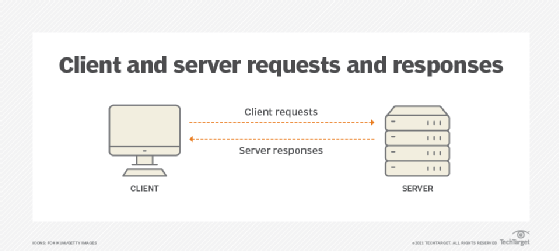
Downloading is the transmission of a file or information from one computer to another over a network, unremarkably from a larger server to a user device. Download can refer to the general transfer of data or to transferring a specific file. It can as well be called to download, DL or D/L.
All internet use requires downloading information. While browsing websites or using apps, the figurer or mobile device is downloading data. This information could be the text, images or videos used on the pages or apps that users visit. Nearly of this data is only kept for long plenty for it to exist used in one case then removed from the device.
When users want to continue the information on their device, they download the data to information technology. This could be a file, document or app that they want to keep permanently. When they download it, users make a copy of the information from what is on the central estimator, called the server.
In general use, the word download is used for both the process of copying the data and for the resulting file. Download is also by and large used in the context of copying data from a larger fundamental server. While non a hard-and-fast rule, if the information is moving between 2 peer client devices or betwixt two pieces of local data storage, such as from a compact disc to a hd drive, information technology would be called transferring data and not downloading.
Taking data or a file from a client device and copying it to a server is called an upload.
What is download speed?
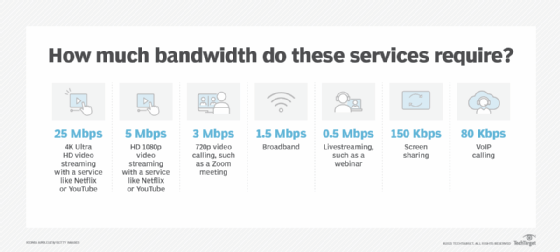
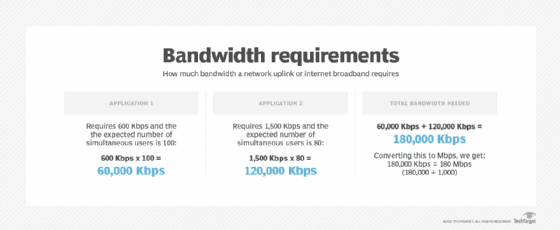
Download speed is a measure of how much data can be transferred from an arbitrary cyberspace location to a user's device in a 2nd. It is typically measured in megabits per 2d (Mbps). The college the number, the faster the connection. The maximum capacity to transfer data of a wired or wireless network in a certain amount of time is referred to as bandwidth.
In the United States, 25 Mbps or over is considered broadband net speed.
For most home or personal internet connections, the upload speed is lower than the download. This is because, for most people, they need to download far more data than they need to upload, so downloads are prioritized by the internet service provider (Internet access provider). Businesses may benefit from having the aforementioned upload speed as their download; this is called having a symmetrical internet connection.
An Internet access provider will advertise the fastest possible theoretical download speed, but many factors tin can touch on real-world download speed. Older home networking or Wi-Fi routers may non be able to provide fast enough connections to support modern internet connections. Poor cellphone or Wi-Fi signal strength too results in boring downloads. In addition, the speed of the server that users are downloading from may not be especially fast.
For instance, large companies accept many servers with exceptionally fast internet connections that can support many devices downloading at high speed simultaneously. Just smaller companies may just have ane server that is hands overwhelmed by many people trying to download something, and the resulting download is wearisome.
What is the departure between download, cache and stream?
When transferring a file to a device, such every bit for music or a video, users may have the choice to download, cache or stream it. While in that location is not a hard-and-fast rule for how different companies use these terms, in general, a download is a permanent copy, a cache is a temporary copy and a stream is but copied as it is used.
To download the information means to have a permanent re-create. The full information is kept on a local device. Ordinarily, stop users manage the copy and have access to use it every bit much every bit they want. They may be able to copy it to another device. An instance download would be to relieve a copy of a document to a device so it is always available.
A cached copy is generally a whole copy that is on the device, simply information technology is managed by the program and not the user. It may non be complete and may require that the service be contacted earlier it can be used over again. The program decides how long the cache copy volition exist and may delete it equally needed. Having cached data is beneficial because less information needs to be transferred and information technology makes the content available faster. Usually, the user will not be able to employ the data exterior the programme. An example of a cache would be a music service having a cache so the songs don't need to transfer data each time they are played or so that they can be available for offline playback.
A streamed copy is when the data is only sent to the device just earlier it is needed and is non kept afterward it has been used. This is most often used for music and movies. Ofttimes, only a few moments ahead of what is existence viewed is sent to the finish-user device. The data is kept in a temporary buffer before it is shown. Once the content is finished, the data is deleted. If the person wants to view it again, another copy needs to be streamed from the server. An example of a stream is when an online video service sends the video data as it is needed, merely if the internet is removed, the stream ends.
Ways to download
In that location are a multifariousness of means to download information, including the following.
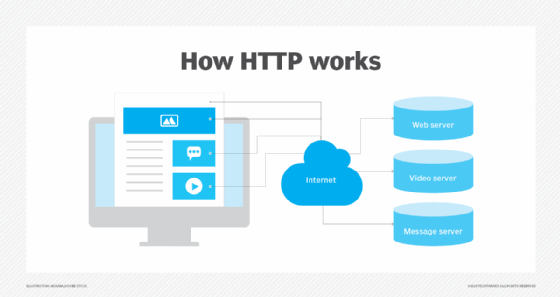
Hypertext Transfer Protocol (HTTP) downloads utilise the same protocol equally browsing websites to transport the file information. It is the most pop style to download files from the internet. All web browsers apply this to download files straight. HTTP does not support pausing or resuming failed downloads natively.
File Transfer Protocol (FTP) is one of the oldest protocols for downloading files. It is used past a dedicated program to log on to an FTP server to browse and download. It can be used with passwords and be encrypted past using FTP Secure.
Peer-to-peer (P2P) downloads use special clients and protocols to send and receive files without a central host. A popular P2P protocol is BitTorrent.
Larn more than most network management .
This was last updated in November 2021
Continue Reading Virtually downloading
- 12 mutual network protocols and their functions explained
- Comparing 7 storage network protocols
- How to arroyo livestreaming bandwidth management
- A deep dive into the internet, bandwidth, and how users in EUC and elsewhere affect chapters
- How do cloud data centers bear on network bandwidth requirements?
Dig Deeper on Network protocols and standards
-

chatty protocol

By: Andrew Zola
-

cache poisoning

By: Rahul Awati
-

archive

Past: Sarah Wilson
-

Azure File Sync service puts pep in hybrid storage setups

By: Brien Posey
Source: https://www.techtarget.com/searchnetworking/definition/downloading
0 Response to "What Saves Everything That Is Uploaded to the Internet"
Post a Comment